The Butterfly Effect in Glass

Allison Eden Studios · The Journal
Allison
Eden’s
Kaleidoscope
Art
One small action can radiate outward and create something much larger. In Allison Eden’s Kaleidoscopes, a single point becomes color, shape, energy, reflection and an entire world of glass.
Allison Eden Studios
Brooklyn, New York
Editorial Feature
“I have always been intrigued by the concept of the butterfly effect—the idea that one small action can radiate outward and create something much larger. My Kaleidoscopes begin the same way: from a single point, color, shape and energy expand outward. I love the idea that a work of art can influence a room, a home, and perhaps even the way someone feels in the world.”
— Allison Eden
Stained glass mosaic art
The eye is drawn to the center, then outward.
There is something almost impossible to ignore about a kaleidoscope. The eye is drawn first to its center, then outward, following repeating shapes, unexpected colors and shifting reflections until the entire composition seems to be moving.
For Brooklyn artist Allison Eden, that sensation became the inspiration for an evolving body of collectible stained glass and mirror mosaic artwork.
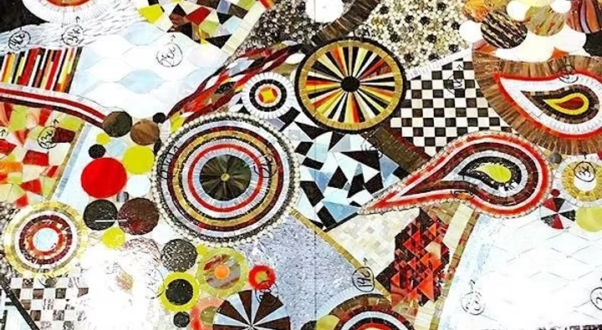
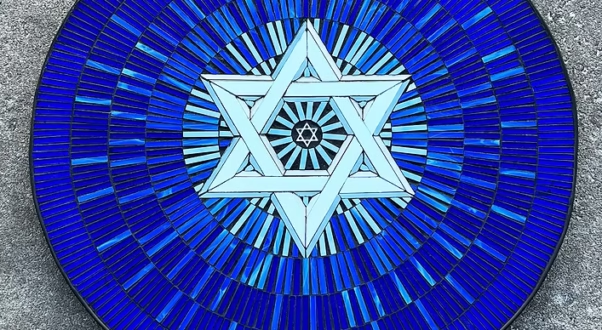
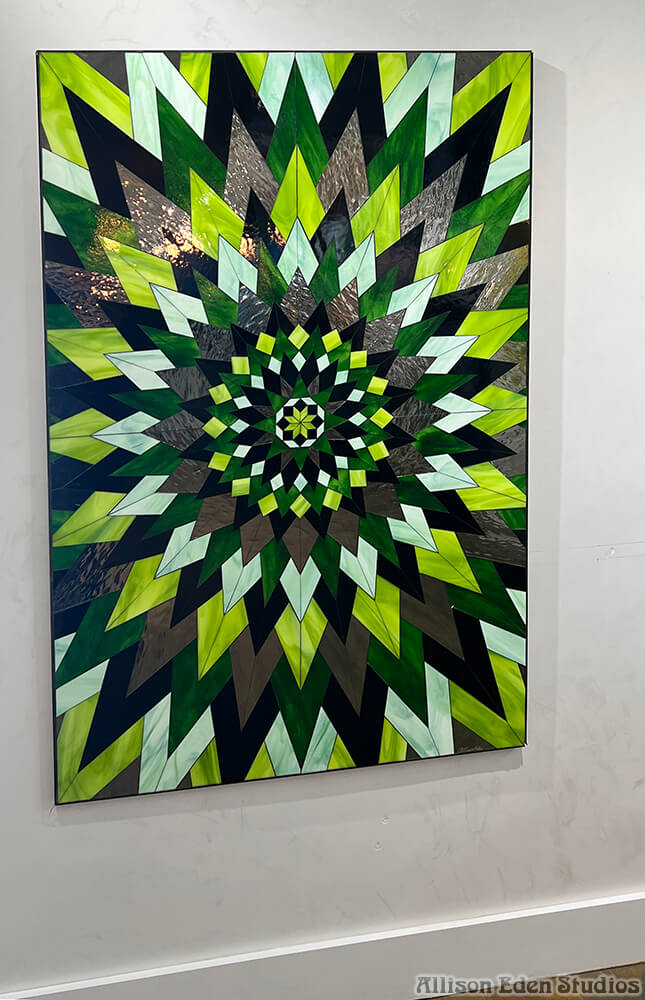
Allison Eden Studios’ Kaleidoscopes are psychedelic bursts of color, geometry, reflection and energy, meticulously handcrafted from stained glass, specialty glass and mirror in the artist’s Brooklyn studio. Some are exuberantly colorful; others are restrained explorations of greens, blues, black, white and shimmering iridescent glass. Some are circular and mandala-like, while others explode across large rectangular canvases.
What unites them is the process. Every Allison Eden Kaleidoscope is individually conceived, drawn, cut and assembled by hand. No two are exactly alike.
For collectors and interior designers seeking original art that can become the visual centerpiece of an interior, the Kaleidoscope collection occupies an unusual place between fine art, glass art, contemporary mosaic and sculptural design.
And unlike an image reproduced on canvas or paper, glass has another participant in the composition: light itself.
What is Allison Eden's Kaleidoscope glass art?
Allison Eden’s Kaleidoscopes are one-of-a-kind contemporary artworks handcrafted in Brooklyn from individually cut stained glass, specialty glass and mirror. Each original composition radiates outward from a central point and can require hundreds or thousands of pieces and weeks or months of design and fabrication.
A Kaleidoscope Begins With a Single Point
The center is everything.
Allison’s Kaleidoscopes begin with a central motif from which the artwork develops outward. Shapes repeat, rotate, multiply and transform as the composition grows.
It is a process that echoes the butterfly-effect concept that initially fascinated the artist: a seemingly small beginning creating increasingly powerful consequences as it moves outward.
But achieving a sense of effortless movement requires an enormous amount of planning. The geometry must work. Colors must balance. Shapes have to communicate with the shapes surrounding them. A single piece of glass that feels insignificant on the worktable may become visually essential once incorporated into the finished composition.
The artwork develops almost like a visual rhythm.
Then comes the glass.
Sheets are considered for color, transparency, texture, reflectivity and movement. A turquoise that appears one way lying flat on a table can become something entirely different when installed vertically. Iridescent glass can shift in color depending upon the viewer’s position. Mirror captures pieces of the surrounding architecture—and occasionally the person standing in front of it.
This makes glass an extraordinarily dynamic artistic medium. The artwork doesn’t simply hang in a room. It interacts with the room.
The artist's hand
Hundreds of Pieces. Countless Decisions. One Original Artwork.
From a distance, an Allison Eden Kaleidoscope may appear almost mathematically perfect. Move closer and the hand of the artist becomes apparent.
Each composition is constructed from hundreds—and in larger works, potentially thousands—of individually considered pieces of glass. Pieces must be selected, cut, shaped, positioned and repositioned as the design evolves.
This is where Allison Eden Studios’ decades of glass-making expertise become particularly important.
Working with stained glass is fundamentally different from working with paint. A painter can mix two colors together to create a third. A glass artist must find the right sheet of glass, identify the right area within that sheet, determine how the material will react to light, cut it into the required shape and then decide how that individual fragment works within the larger composition.
The process cannot be rushed.
Craftsmanship
Slowly. Precisely. By hand.
There are no computer-generated shortcuts that can reproduce the subtle differences in hand-selected glass, the imperfections of a hand-cut edge or the way one reflective surface responds to another.
01 · SELECT
Material
Every sheet is considered for color, transparency, texture, reflectivity and movement.
02 · CUT
Individual fragments
Pieces are selected, cut and shaped according to the evolving geometry of the artwork.
03 · ASSEMBLE
One composition
Sections develop gradually as pieces are positioned and repositioned until the visual rhythm is complete.
Allison’s Kaleidoscopes are therefore created the old-fashioned way: Slowly. Precisely. By hand. That labor is part of what gives each finished work its rarity.
Why No Two Kaleidoscopes Can Ever Be Exactly Alike
The variations are part of the artwork.
Even if Allison wanted to reproduce a Kaleidoscope exactly, the nature of the material would make a truly identical second work virtually impossible.
Stained glass is inherently variable. Veining moves through one sheet differently from another. Color density changes. Iridescent surfaces react unpredictably to light. Hand cutting introduces minute variations. Mirror reflects whatever environment surrounds it.
These aren’t flaws to be eliminated. They are part of the artwork.
It means the collector isn’t simply acquiring a pattern or design. The collector is acquiring a particular combination of materials, decisions and craftsmanship that exists in that precise form only once.
For an art collector, this distinction matters. In an age when imagery can be reproduced almost infinitely, an object made slowly by hand has become increasingly meaningful. The physical presence of the maker remains embedded in the finished work.
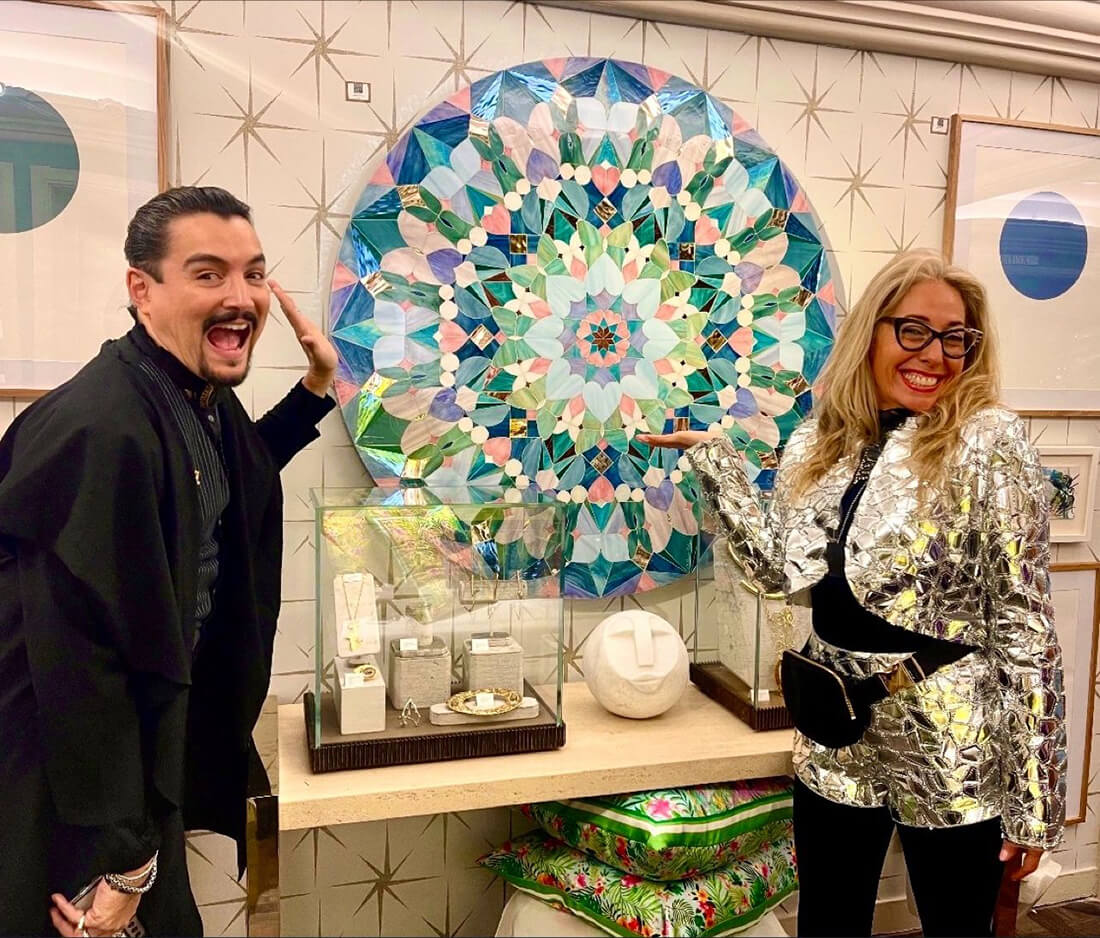
An artwork with multiple experiences
an Allison Eden Kaleidoscope rewards close inspection because its complexity reveals itself gradually. From across a room, it is a powerful graphic statement. At several feet away, individual colors and reflective surfaces emerge. Up close, the viewer can see the individual pieces that create the illusion.
One artwork offers multiple experiences depending upon where you stand.
Glass Artwork That Changes With the Room
The artwork doesn't simply hang in a room. It interacts with the room.
Interior designers frequently search for a piece of art capable of anchoring an entire room. A large-scale Kaleidoscope can do precisely that.
The geometry establishes a focal point while stained glass introduces saturated color without the flatness of paint. Mirror and iridescent materials bring surrounding colors into the artwork itself.
This gives the work an unusual adaptability within luxury interiors.
Place a Kaleidoscope opposite a window and daylight becomes part of its appearance. Place it within a dramatically lit entry and reflective elements respond to artificial light. Surround it with richly colored furnishings and those colors can appear in mirrored fragments.
As someone walks past the artwork, the perception changes again. In this sense, the work possesses a subtle kinetic quality despite remaining physically still.
For Allison, this interaction is essential. Her art isn’t intended merely to coordinate with an interior. It is intended to give the interior energy.
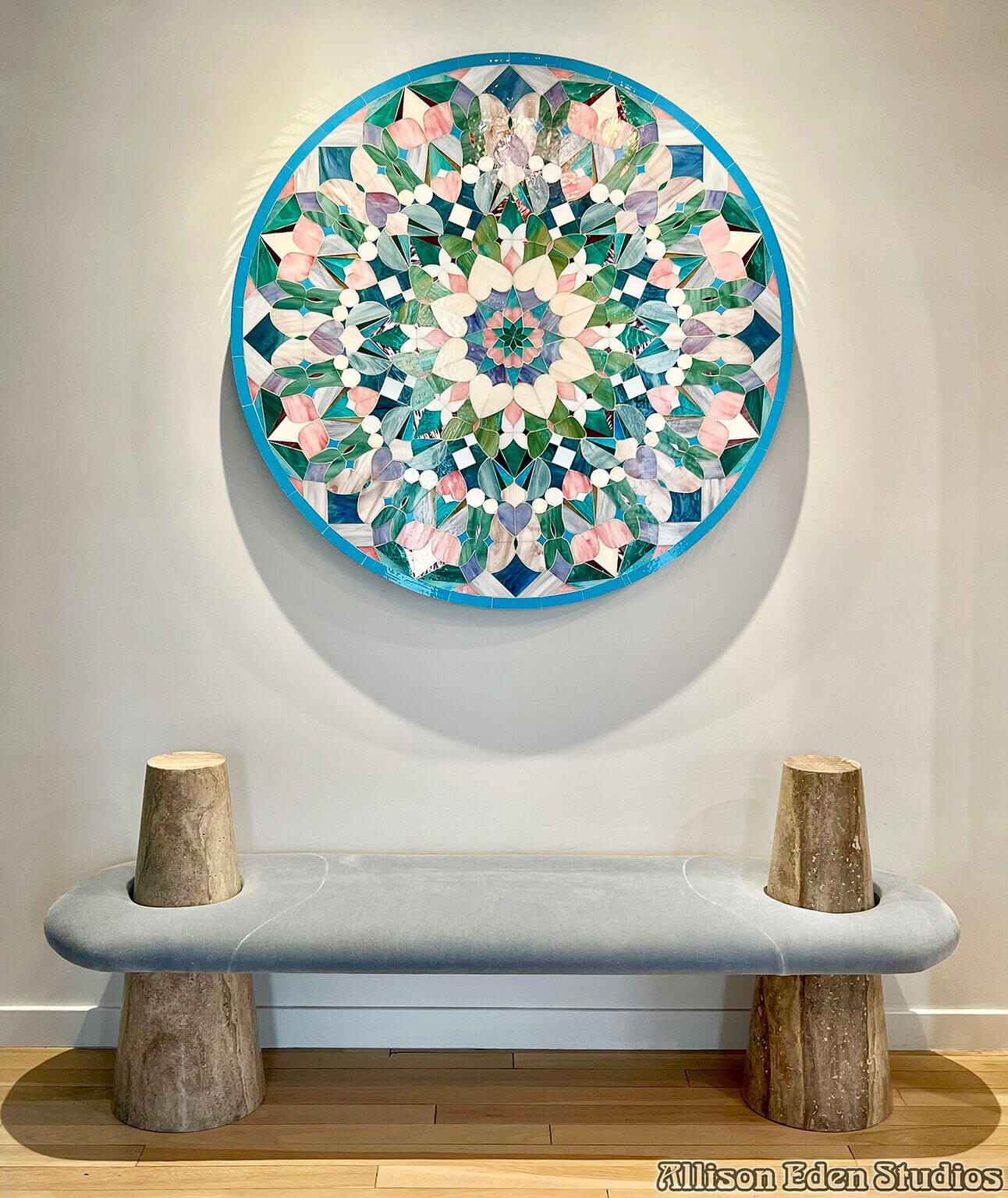
From Psychedelic Color to Sophisticated Monochrome
Extraordinary range within a single artistic language.
One of the strengths of the Kaleidoscope collection is the extraordinary range possible within a single artistic language.
Some works explode with saturated reds, yellows, blues, greens, pinks and unexpected fragments of specialty glass. These pieces have an unmistakably joyful, psychedelic quality.
Others demonstrate how dramatically the concept can change through palette alone.
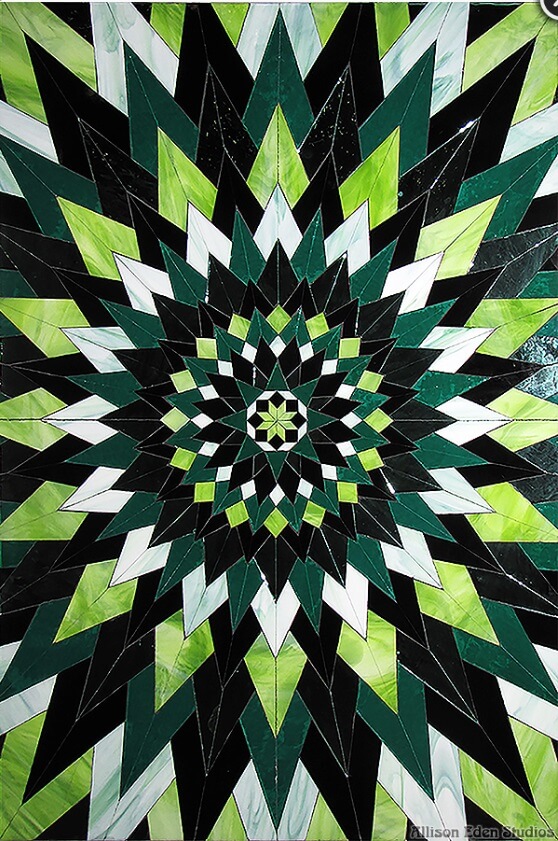
A Kaleidoscope constructed in shades of emerald, lime, mint, black and reflective glass becomes sophisticated and architectural.
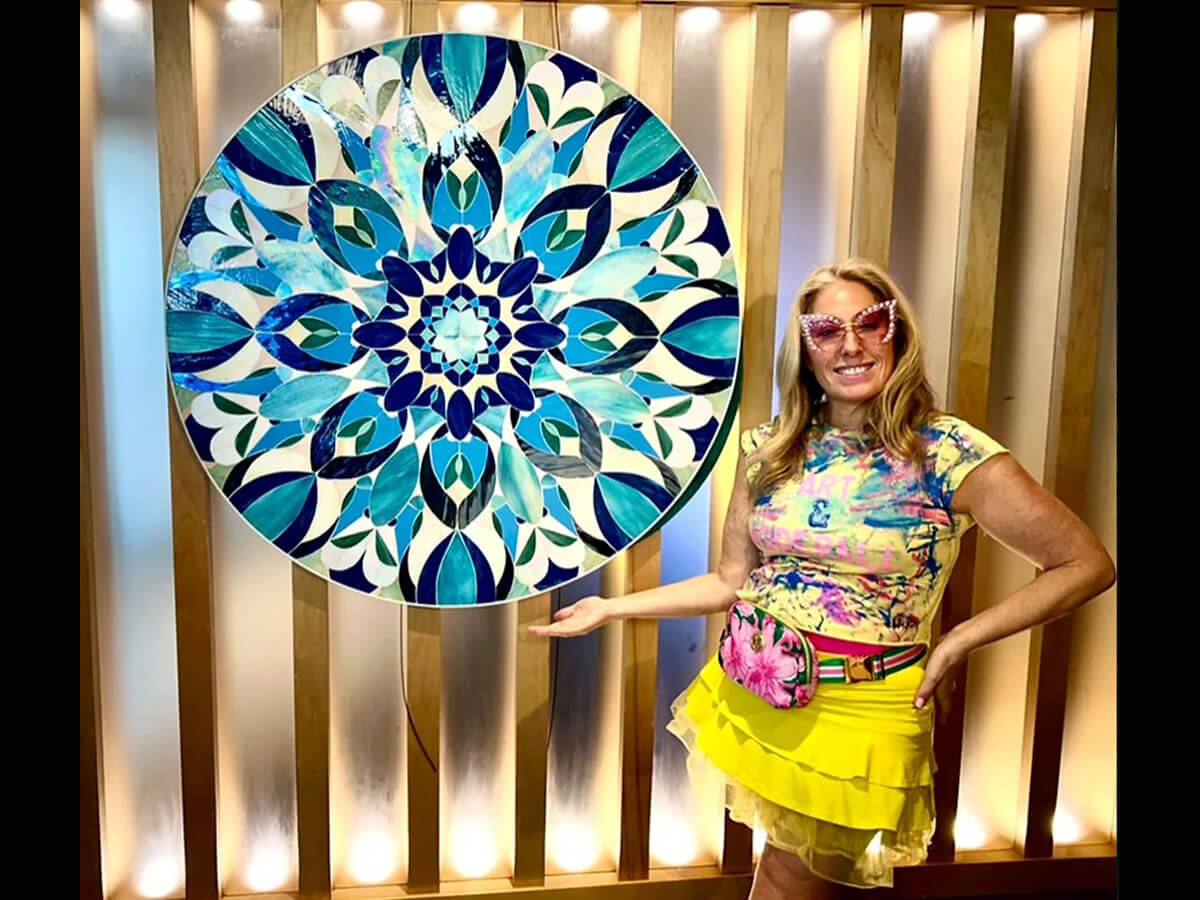
A blue and turquoise circular composition feels aquatic and serene.
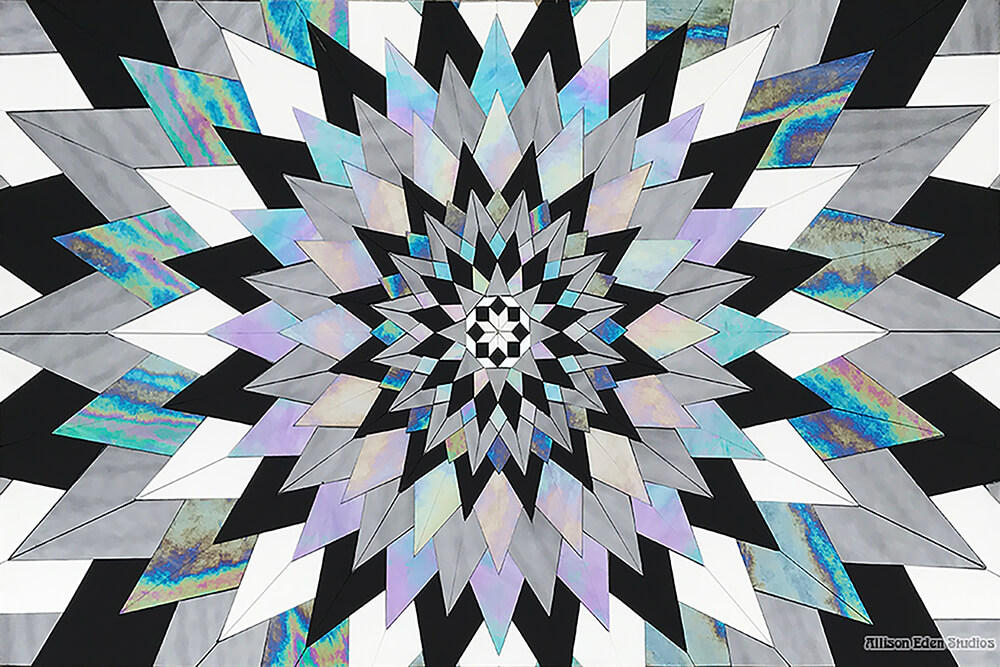
A predominantly black, white, gray and iridescent work becomes almost jewel-like, allowing geometry and reflection rather than color to command attention.
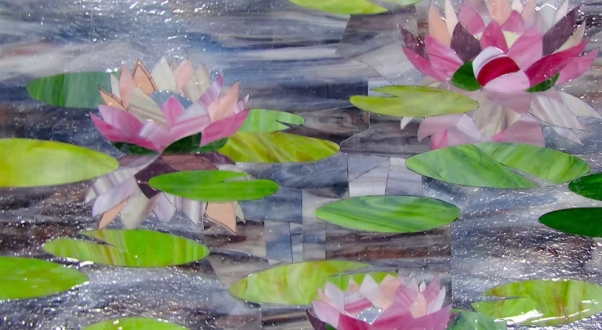
And softer compositions in blush, pale blue, aqua, green and lavender can take on an almost botanical quality.
The underlying principle remains the same: Start at the center. Let the idea radiate outward.
For interior designers, this range makes the collection especially interesting. A Kaleidoscope can be selected or commissioned to respond to an interior without becoming simply another decorative element. It remains unmistakably an Allison Eden.
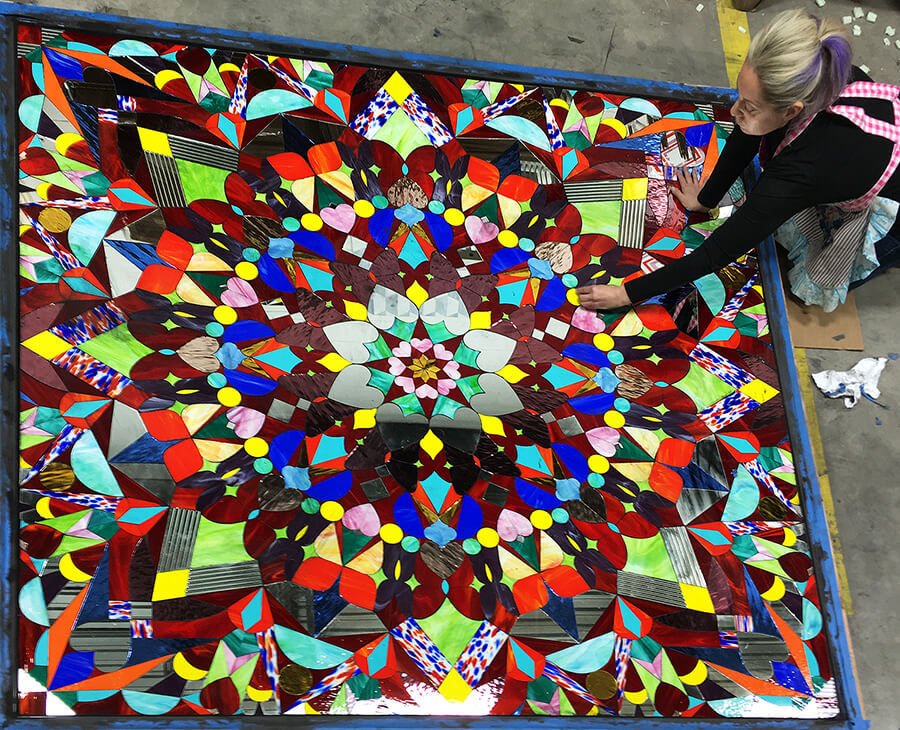
The Mega Kaleidoscope: When Allison Decided to Go BIG
84"
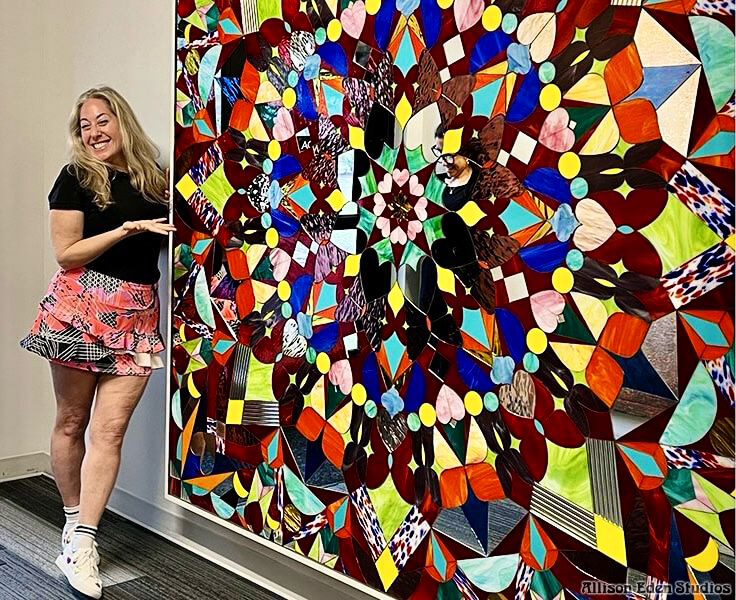
84" × 84" stained glass and mirror mosaic artwork.
Glass Artwork That Changes With the Room
What happens if we make it enormous?
When Allison began developing the Kaleidoscope concept, one thought kept returning: What happens if we make it enormous?
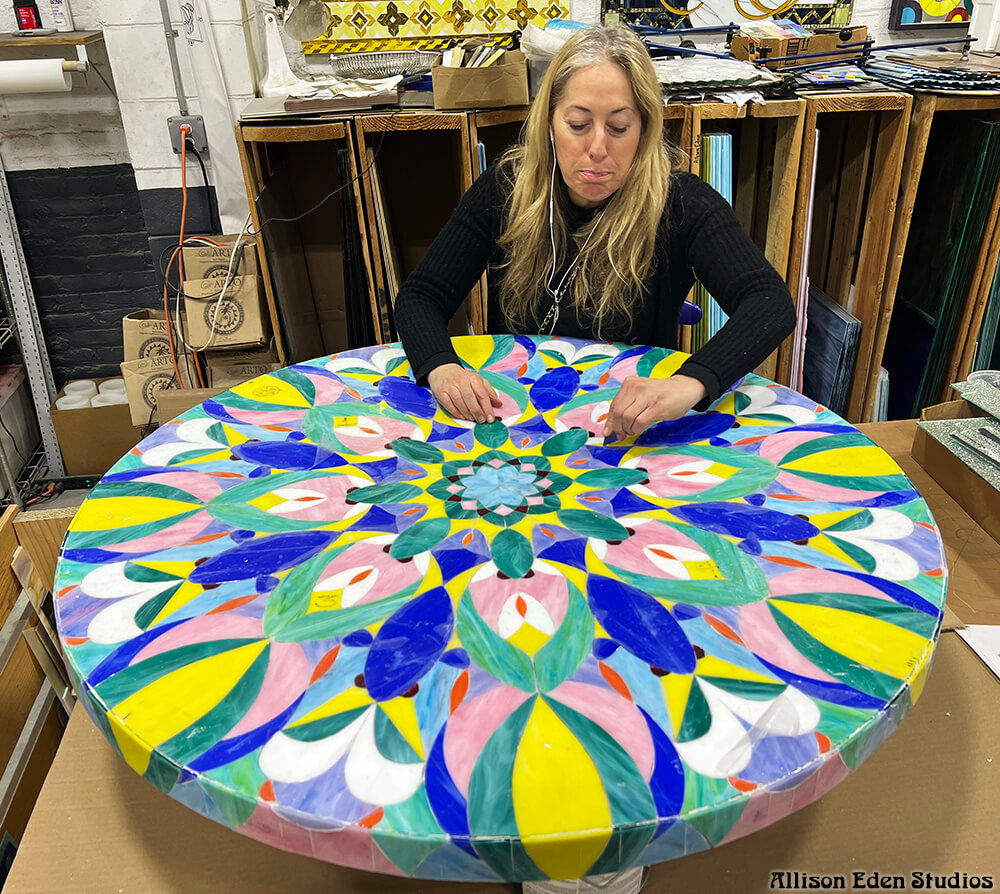
The answer became the Mega Kaleidoscope, an extraordinary 84″ x 84″ stained glass and mirror mosaic artwork.
At seven feet square, the piece is less something to look at than something to experience.
Multiple primary and prismatic colors radiate outward through an intricate composition of stained glass, specialty glass and reflective materials. From its central point, the artwork expands into an enormous visual explosion.
The scale amplified everything Allison loved about the concept. A small change at the center ultimately influences a composition spanning seven feet in each direction—the butterfly effect translated into glass.
Creating a work of this magnitude required not only artistic vision but extraordinary technical discipline. Every shape had to relate to the next while simultaneously serving a composition too large to absorb from a single working position.
From Brooklyn Studio to Museum Collection
The artwork began at a worktable in Brooklyn—and traveled far beyond it.
Once completed, the Mega Kaleidoscope began a journey of its own.
The artwork traveled around the United States and was exhibited at shows in Las Vegas, Chicago, Miami and New York City’s Javits Center, introducing audiences to the scale and complexity possible in contemporary glass mosaic art.
Eventually it returned to Brooklyn, where it became the crown jewel of Allison Eden Studios.
But its story didn’t end there.
The Mega Kaleidoscope ultimately entered the permanent collection of the Wiener Museum of Decorative Arts (WMODA) in South Florida.
For Allison, seeing a piece that began on the worktables of her Brooklyn studio become part of a museum collection represented a particularly meaningful chapter in the Kaleidoscope story.
Ancient medium. Contemporary attitude
Mosaic doesn't have to look ancient.
It also demonstrates something central to her approach.
Mosaic is an ancient artistic medium, but Allison has never believed it needs to look ancient.
Glass mosaic can be Pop Art. It can be psychedelic. It can be glamorous, humorous, architectural, geometric, fashionable or exuberantly contemporary.
The technique may be centuries old. The attitude doesn’t have to be.
Across fine art, fashion, retail and interior design.
Over the years, Allison Eden’s artwork has crossed boundaries between fine art, fashion, retail and interior design.
Her Kaleidoscopes and other glass artworks have been sold through Bergdorf Goodman and galleries, exhibited to design audiences and featured in Bloomingdale’s New York holiday windows. Her work can be found in residences and projects across the United States and internationally.
That history reflects the unusual versatility of the medium.
A Kaleidoscope can feel entirely at home in a gallery. It can become the centerpiece of a dramatic living room. It can transform an entrance hall into an experience. And at monumental scale, it can command a public or museum environment.
Yet regardless of where the finished work ultimately lives, it begins in essentially the same place: at a worktable in Brooklyn, surrounded by sheets and fragments of glass.
The Artist's Hand Matters
Experience doesn't make the process instantaneous.
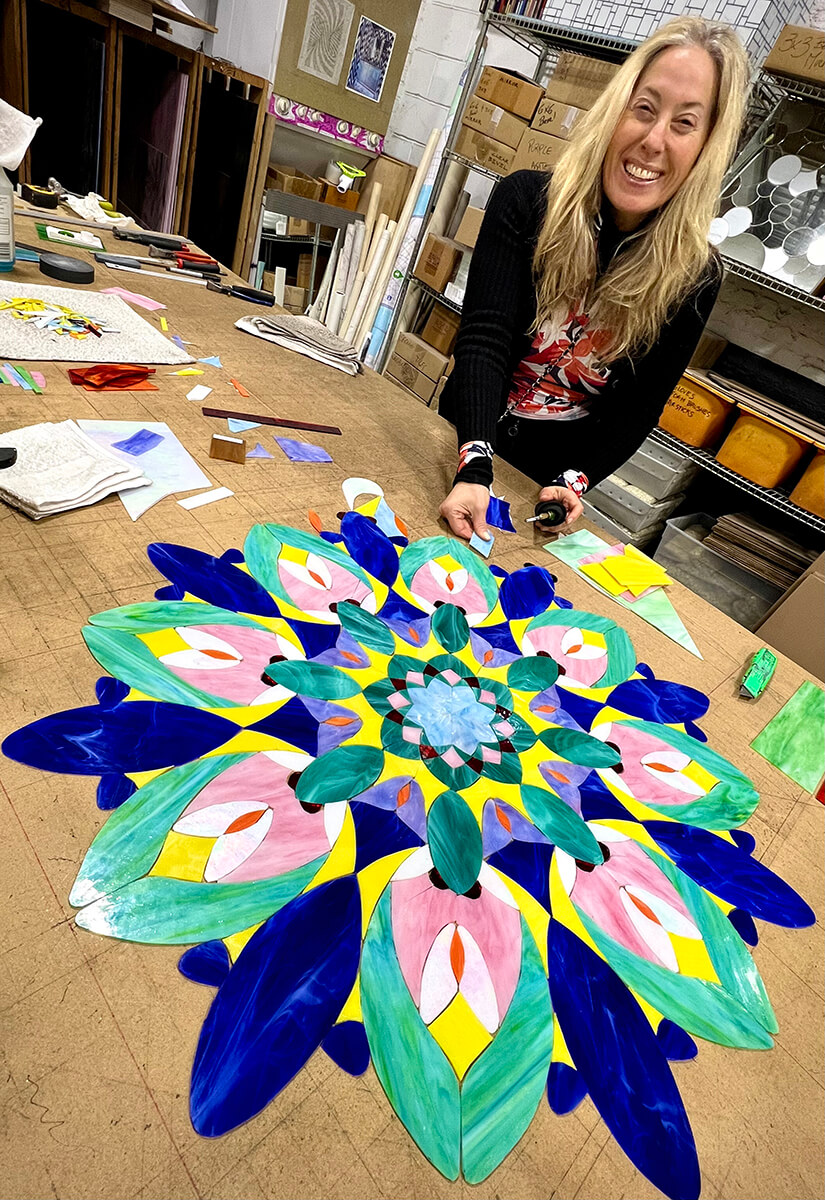
Photographs of Allison making these works reveal something a finished installation can sometimes conceal: the sheer physicality involved.
Glass is spread across the table. Individual pieces are tested against neighboring colors. Shapes are cut and refined. Sections develop gradually before the entire composition can finally be seen as a whole.
Hands touch virtually every piece.
That matters to Allison.
After more than three decades working in glass, she understands both the limitations of the material and the possibilities hidden within it. Experience makes it possible to envision how a particular piece will behave before it becomes part of the finished work.
But experience hasn’t made the process instantaneous. Quite the opposite.
The more complex the artwork becomes, the more decisions there are to make.
A large Kaleidoscope represents weeks or months of concept development, material selection, cutting, arranging, revising and fabrication.
The time invested is not incidental to the work. It is part of its value.
Collecting an Allison Eden Kaleidoscope
Recognizable. Individual. Original.
For collectors, one of the pleasures of an Allison Eden Kaleidoscope is that the work is immediately recognizable yet individually distinctive.
There is a visual vocabulary: radial geometry, extraordinary color, stained glass, mirror, repetition, symmetry and an almost compulsive attention to pattern.
But there isn’t one fixed Kaleidoscope. Each artwork develops its own personality.
That makes the series particularly appropriate for collectors who want an artist’s recognizable body of work while still owning something genuinely individual.
Collectors can discover existing original works or commission an artwork conceived for a particular setting, scale or palette. A bespoke piece can respond to architecture and color while retaining Allison’s artistic language and authorship.
The objective isn’t to make art that disappears politely into a room. It is to create the piece that people remember after they leave the room.
One piece of glass at a time.
Perhaps that is ultimately why the Kaleidoscope has remained such a compelling subject for Allison Eden.
Every artwork begins small.
One central shape.
One piece of glass.
One decision.
Then another piece is added. And another.
Color begins to move. Geometry develops. Reflections multiply. What started as a small idea expands until it occupies an entire wall.
Then the artwork leaves the studio.
It enters a home, a gallery or a museum. Someone sees it. Someone responds to it. The atmosphere of the space changes.
And the original idea continues radiating outward.
That is Allison Eden’s butterfly effect.
One piece of glass at a time.
Custom glass mosaic art
Create the piece people remember.
For collectors and interior designers seeking original art, Allison Eden's Kaleidoscopes can be discovered as existing works or conceived as bespoke pieces for a particular setting, scale or palette.